Waialae Beach Park opens quietly. A concrete bridge crosses Waialae Stream just past the parking lot, the water beneath it running slow and shallow into the reef channel that surfers call Razors. A hau tree throws shade over the picnic tables on the near side. Cross the bridge and the grass opens into a long lawn, the kind toddlers make a beeline for, before the sand starts and the coastline bends west toward Diamond Head.
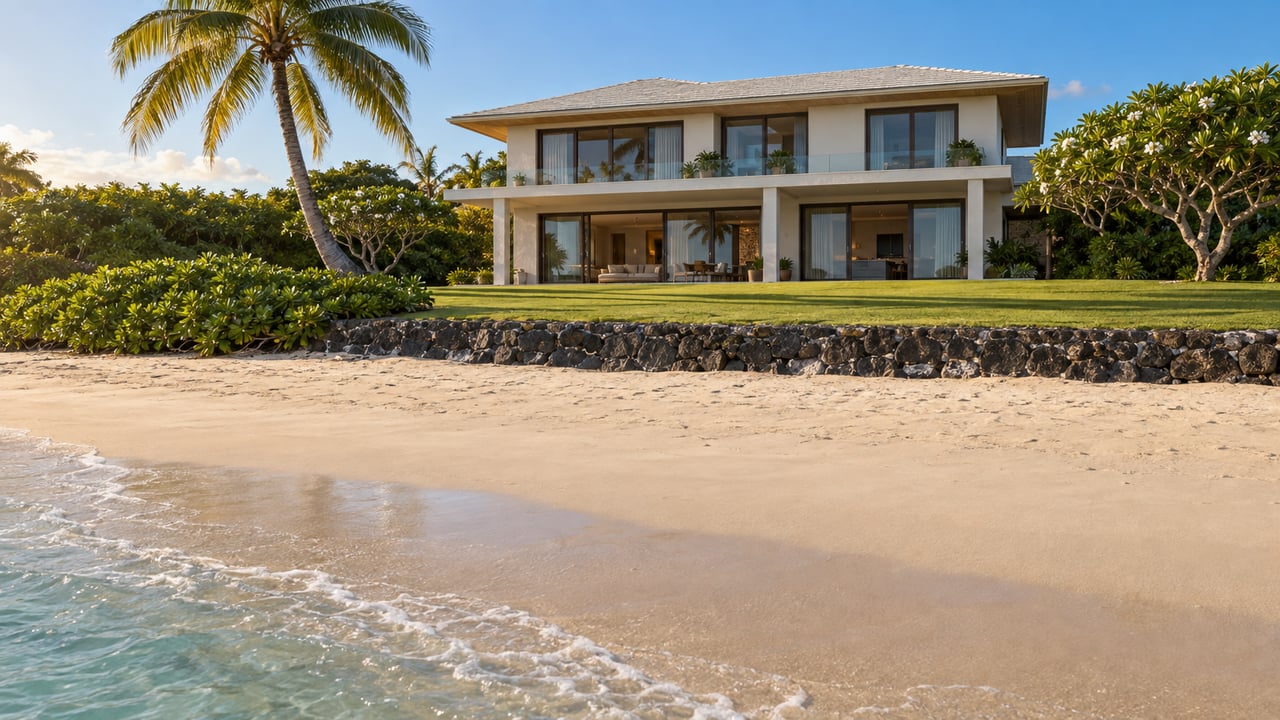
Most people who park here treat it as a destination. It's actually a starting point. Keep walking west along the sand and you're no longer in a city park. You're on Kahala Beach, walking directly in front of some of the most expensive residential frontage on Oahu, along a shoreline that belongs to nobody who lives behind it, as the Hawai‘i Department of Land and Natural Resources explains.
A Beach That Doesn't Stop at the Property Line
The Honolulu Star-Advertiser reports that Hawaii defines its shoreline by a specific, almost technical measure: the upper reach of the wave wash during the highest seasonal tides, not storm surge, not a fence line, not wherever a landscaper happened to plant naupaka. Whatever sand sits below that line is public land, a transit corridor open to anyone on foot, regardless of what's built behind it. That single rule is why a stretch of coast fronting nine-figure estates on Kahala Avenue functions, in practice, as a public beach walk with no gate, no dues and no one to ask permission from.
It's an unusual thing to internalize about a neighborhood known for privacy. The homes along Kahala Avenue are set back, landscaped, often screened by hedges. But the beach in front of them was never part of the deal. Walk west from Waialae Beach Park and the sand carries you along that entire run of frontage, past homes most people only ever see from the street, until the shoreline curves toward the Kahala Hotel & Resort's grounds.
That's where the walk changes character again. At the east end of Waialae Beach, a small man-made island was built in 1963 during construction of the hotel, a detail easy to miss unless you already know to look for it. Just past it sit the resort's saltwater lagoons, home to Dolphin Quest's animals, visible from the public sand without setting foot on hotel property. It's one of the odder juxtapositions on the island: a quiet neighborhood beach walk that ends, without transition, at a view of dolphins in a lagoon built for hotel guests, all of it still legally the same public shoreline you started on.
Go the other direction from Waialae Beach Park, east instead of west, and the sand turns coarser, mixed with coral rubble that's better for shell hunting than swimming. That stretch continues on toward Wailupe and Kawaikui beach parks, a longer and less traveled walk that most guides skip because there's no single photogenic landmark to anchor it. It's simply more coastline, connected the same way, under the same rule.
What the Walk Actually Requires
None of this is a swimming beach in the postcard sense. The bottom at Waialae Beach Park is a mix of coral rock and soft sand, and the water stays shallow and reef-strewn for a good distance out, which makes the walking better than the wading. There's no lifeguard on duty at Waialae Beach Park, a fact worth knowing before wading in past ankle depth, and the water here is tested every other week by Surfrider's local monitoring program rather than left unchecked.
Parking is a small, free lot right at the park entrance, and it fills fast on weekend mornings. Street parking nearby is limited and shares the block with the Waialae Country Club and hotel property lines, so arriving early is less a suggestion than a practical necessity if you want an actual spot rather than a loop around the block. For anyone without a car, TheBus routes 22, 14 and 9 all serve the area, with the 22 dropping riders at Kahala Mall, a short walk from the park entrance.
The footing rewards a little planning. Because the bottom near the stream mouth and the reef channel is uneven, the walk is more comfortable at lower tide, when more sand is exposed and less coral is underfoot. Reef shoes or an old pair of sandals do more work here than they would at a sandier south shore beach.
Kahala's coastal life isn't only a daytime routine. A few blocks inland, Kahala Park hosts a monthly star party run by the Hawaiian Astronomical Society, typically running from early evening into the night. It's a small, recurring detail that says something about how this neighborhood actually gets used across a full day, not just during the hour when the light is good for a walk on the sand.
Taken together, the walk from Waialae Beach Park to the Kahala Hotel's lagoon and back covers roughly the same ground whether you do it once or every week. What changes is how it reads once you know the legal mechanics behind it. The homes along Kahala Avenue are as private as real estate gets on this island. The beach they sit on never was.
If you want more of Kahala's quieter details, the kind that don't show up on a map, NS Luxury Living is happy to point you toward them. Reach out anytime to talk through what else is worth knowing about this stretch of coast.
This article is general information, not legal, tax or financial advice. Consult a qualified professional about your situation.