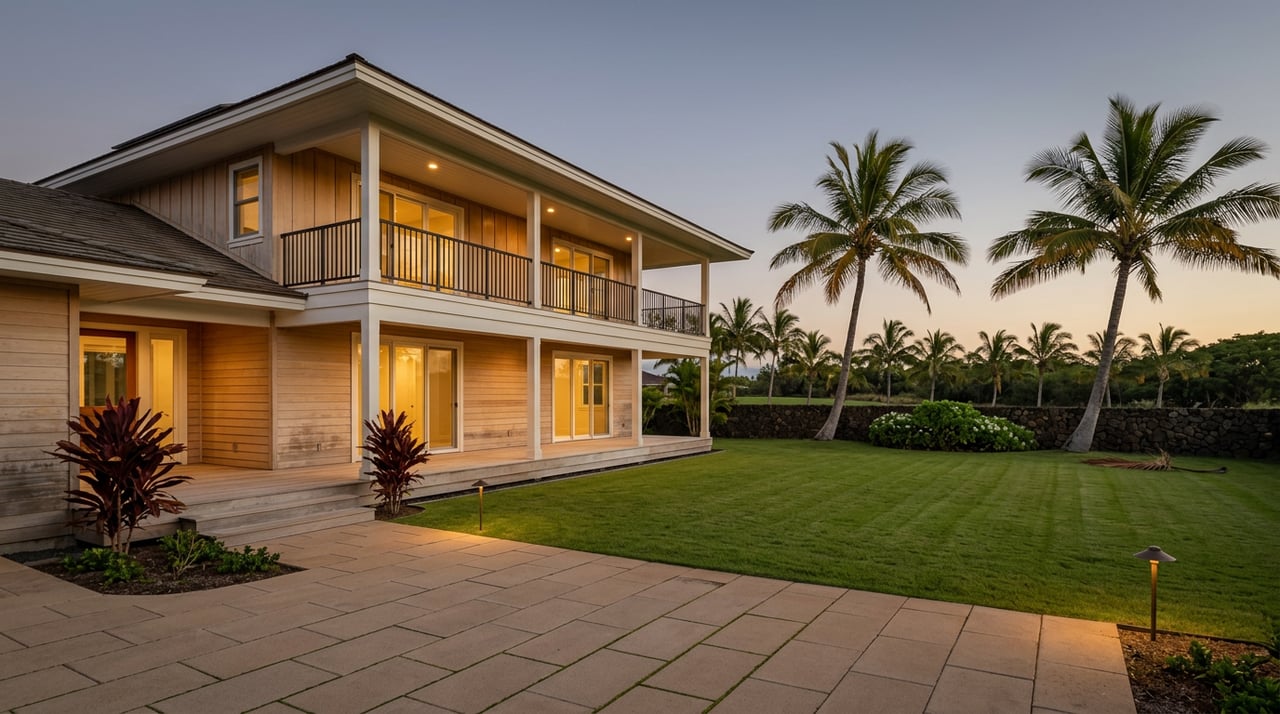
If you've done the Kuilima Golf Course loop lately and hit a stretch where the view of the fairway suddenly disappears behind green dust fencing, you may have assumed the big Turtle Bay hotel fight finally caught up with the trail. It didn't. That fencing belongs to a different developer, on different land, moving on a timeline a judge's ruling doesn't touch.
Two Turtle Bay expansion stories have been running side by side for two years now, and this past July they split further apart than most people following the headlines realize. One got stopped in court. Construction on the other continued under a separate approval on separate land.
The Ruling Everyone Read the Same Way
In July 2026, First Circuit Court Judge Shirley Kawamura ruled that Host Hotels & Resorts cannot move forward with its planned 375-room hotel on the 49-acre parcel next to the Ritz-Carlton Oahu, Turtle Bay without a new supplemental environmental impact statement. The city's Department of Planning and Permitting had approved the project in December 2025 by relying on a 2013 environmental review, arguing the new hotel fell under the 530-unit cap that review had already studied. Earthjustice, representing the Center for Biological Diversity, the Conservation Council for Hawaii, and the community group Kūpaʻa Kuilima, sued in February 2026, arguing that thirteen years of ecological change on that shoreline had gone unexamined.
The evidence that moved the judge was small: two species of Hawaiian yellow-faced bee, listed as endangered in 2016, three years after that 2013 review was finalized. Surveys since then have documented the bees living in and around the project site, along with a Laysan albatross colony that established itself at Kahuku Point in 2018 and a rise in Hawaiian monk seal pupping on the beaches fronting the development. None of that existed on paper when the city said the old EIS was good enough. Judge Kawamura ruled the city has to start the environmental review over before it can issue building permits.
Host Hotels said in a statement that it is evaluating its options and remains focused on what it called sustainable and responsible ownership across its Hawaii portfolio.
The Fence You're Actually Walking Past
Here's what the ruling didn't reach. On the opposite side of the resort, between the current hotel and Kahuku Point, a Utah-based developer called Arete Collective, working with the Wasatch Group, bought roughly 65 acres for $43 million back in 2024. That land splits into two parcels: RR3, permitted for up to 100 residential units, and H2, permitted for up to 250. Combined, that's up to 350 units, on entitlements that trace back to a 2015 conservation settlement, not the 2013 review at the center of this summer's lawsuit.
Honolulu Civil Beat's own coverage of the July ruling was direct about this. The 350-unit Arete project began construction in August 2024, nearly two years before the ruling, and the ruling doesn't immediately affect those plans because it's a separate approval on separate land. Vertical construction on RR3's first phase resumed with contractor Nordic PCL, and Arete's own project updates describe utility installation continuing along Kaihalulu East Drive, drainage basin grading, and shoreline restoration work, including more than 2,500 native plants installed along the coast in 2025 alone.
So the confusion is understandable. Both projects sit on former Turtle Bay Resort land. Both involve the words "endangered species" and "environmental review" somewhere in their history. Both generate the kind of green construction fencing that makes a golf course trail feel temporarily rerouted. But one is legally frozen and one is not, and knowing which is which changes how you read what's actually in front of you on a walk.
| Host Hotels expansion | Arete Collective / Wasatch | |
|---|---|---|
| Location | 49-acre H-1 parcel, adjacent to the current Ritz-Carlton | RR3 and H2 parcels, between the resort and Kahuku Point |
| Scale | Up to 375 hotel rooms, spa, retail | Up to 350 residential units across two parcels |
| Legal status as of September 2026 | Paused, new supplemental EIS required before permits can issue | Unaffected by the July ruling, active construction |
| What you'll see on the ground | No visible groundbreaking yet | Fencing, grading, utility trenching near the Palmer Course |
How Long "Paused" Actually Lasts
A pause is not the same as a decision. A new supplemental environmental impact statement requires Host Hotels to consult with the permitting department, neighborhood boards, and other stakeholders, a process that alone can run months to over a year. On top of that sit two separate public comment periods on the draft review, both of which need approval from the state's Environmental Review Program before anything advances. Depending on how contested those comment periods get, the realistic range Civil Beat's reporting points to runs from one to three years before Host Hotels could have a new EIS in hand, let alone a building permit.
That timeline matters if you're planning around this land rather than just walking past it. The H-1 parcel is not going to look different by next spring. The RR3 and H2 parcels might.
The Golf Course Doesn't Belong to One Builder Anymore
One detail that doesn't make the lawsuit coverage but shapes the daily experience more than people expect: Arete Collective took over management of the resort's Fazio and Palmer golf courses, along with the staff who run them. That's a meaningful shift from a straightforward land sale to actual day-to-day stewardship of terrain the trail network runs through. It also explains why a hiker on the AllTrails-mapped Kuilima Golf Course loop might notice construction crews working within view of the fairway rather than off in some cordoned corner. The developer and the golf operation are, for practical purposes, the same outfit now.
What Hasn't Slowed Down
None of this has touched the resort's daily rhythm. The Ritz-Carlton Oahu, Turtle Bay achieved LEED Gold Certification this year, a recognition tied to energy efficiency and environmental stewardship that sits a little uneasily next to the ongoing lawsuit, though the two aren't in direct conflict since they cover different parts of the property. General manager Doug Chang, a native Hawaiian who has spent decades in island hospitality, has kept the resort's identity intact through the ownership change from Blackstone to Host Hotels, famously fielding more questions about whether "turtle" would disappear from the name than about the legal fight next door.
On the food side, the resort's signature restaurant Alaia launched its Town & Country Chef Series this year, opening with a May visit from Chef Sheldon Simeon, the six-time James Beard nominee and author of Cook Real Hawaii, cooking alongside Executive Chef Daniel Quintero. Alaia's kitchen draws from Kuilima Farm, more than 460 acres of the resort's own agricultural land, which is part of what gives the menu its farm-to-table claim some actual weight rather than just marketing language.
If you live near Turtle Bay, that's the useful takeaway heading into fall: the legal fight over the H-1 parcel is genuinely paused, likely for a year or more, while the Arete project keeps building on a completely separate timeline toward an early 2027 completion for its first phase. The trail fencing you're navigating around this month is telling you which project you're actually looking at, if you know what to look for.
If you're thinking about what any of this means for property near Turtle Bay, whether you already own here or you're weighing the North Shore against other parts of Oahu, NS Luxury Living tracks these development timelines as closely as the listings themselves. Schedule a private consultation with Jill to talk through what's actually happening on the ground here, not just what the headlines say.
This article is general information, not legal, tax or financial advice. Consult a qualified professional about your situation.